


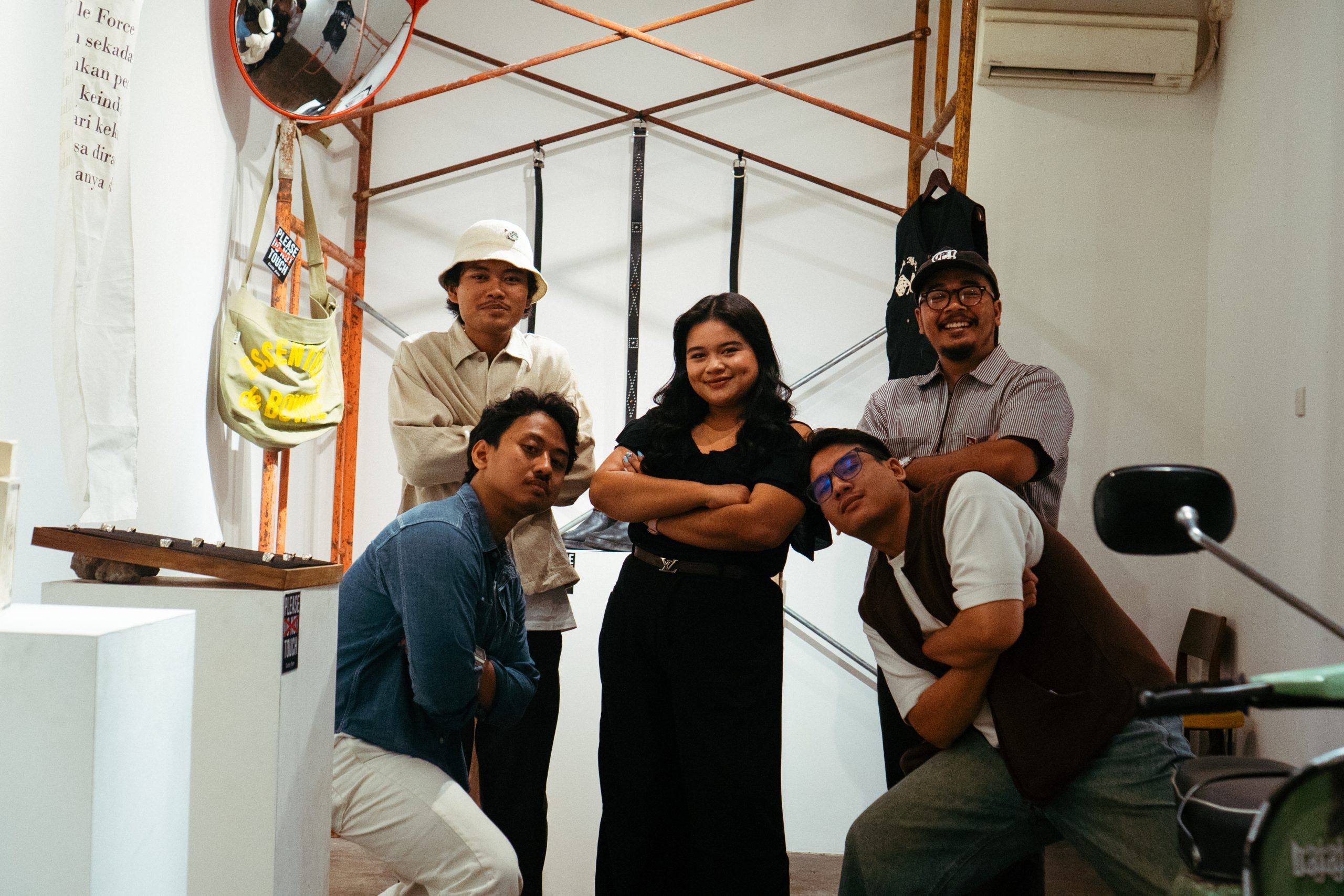
THE THINGS WE CARRY
Craft, Identity, and Everyday Life
There is something deeply human in the things we choose to make, keep, wear, and live with.
An object may begin as a material—leather, silver, clay, wood, stone, or the many surfaces that shape our surroundings—but through the hands of its maker, and eventually through the life of its owner, it begins to acquire another kind of meaning. It carries traces of labour, gestures, preferences, memories, and use. Over time, an object can become more than what it was made to be. It becomes personal.
The Things We Carry brings together four Bali-based creative practices—Bowie Riding Essentials, Treasure Creation, Axceramicss, and Dumogi Studio—in a shared exploration of contemporary craft, materiality, identity, and everyday life.
Although their practices emerge from different disciplines, they share an attention to the relationship between the hand, the material, and the human experience. Their work is not simply concerned with how an object looks, but with how it is made, how it is encountered, and how it becomes part of a life.
For Bowie Essentials, making is closely connected to movement. Rooted in a love for motorcycles, vintage culture, and the world of riding, Bowie creates leather bags, boots, belts, and other riding essentials through a made-to-order approach. The objects are designed to be used rather than simply displayed. They are exposed to weather, movement, friction, time, and the inevitable marks that come with a life on the road.
This relationship with use extends into the brand’s restoration practice. Rather than treating wear as something that diminishes an object’s value, Bowie approaches the traces of time as part of its history. A worn leather piece can be repaired, restored, and returned to use. In this sense, restoration becomes an act of continuation—a way of allowing an object to carry its previous life into the next one.
In Treasure Creation, material takes a different form. Based in Celuk, a community long associated with Bali’s silversmithing tradition, the practice works with sterling silver to create contemporary jewellery. Yet jewellery has always occupied a particularly intimate place in human culture. It sits close to the body, becoming intertwined with the gestures, habits, and identity of the person who wears it.
Treasure Creation approaches silver not simply as a precious material, but as a medium through which personality can be expressed. Each piece can become an extension of the wearer—something subtle, distinctive, and deeply personal. Within the context of Bali’s established jewellery-making culture, the practice reflects an ongoing dialogue between inherited craftsmanship and contemporary forms of individual expression.
If leather speaks through use and silver through proximity to the body, Axceramics allows material itself to become the central voice.
The artisanal ceramics practice by Axdammm explores clay through shaping, carving, firing, glazing, and high-firing processes. Across these stages, the material is never completely controlled. Clay responds to pressure, temperature, moisture, gravity, and time. The process leaves its own evidence.
This becomes an important part of the work. Rather than attempting to erase the traces of making, Axceramicss allows them to remain visible. Marks, irregularities, textures, and variations become reminders that these objects have passed through human hands. They occupy a space between function and expression, where an everyday ceramic object can also become a record of process and touch.
Dumogi Studio expands this conversation from the individual object into the spaces we inhabit.
Working across interior design, material, and atmosphere, Dumogi considers how objects and architecture come together to shape everyday experience. A room is never simply an empty container. The materials we encounter, the objects we place around ourselves, the proportions of a space, the light, texture, and rhythm of movement all contribute to how a place feels and how we experience ourselves within it.
Dumogi’s practice therefore approaches design as an act of creating relationships: between architecture and objects, between function and visual character, and ultimately between people and the spaces they occupy.
Seen together, these four practices reveal a broader understanding of contemporary making in Bali.
Their work moves beyond the familiar distinction between craft and design. Instead, it suggests a more fluid territory where traditional skills, contemporary aesthetics, personal interests, and everyday needs intersect. A leather bag can become a companion on the road. A silver object can become part of someone’s identity. A ceramic vessel can retain the memory of the hand that shaped it. An interior can influence the way a person moves, rests, gathers, and lives.
What connects them is not a particular material or technique, but an attitude toward making with intention.
In a world increasingly dominated by speed, repetition, and mass production, these practices remind us of the value of objects that retain a sense of their origin. They remind us that there is meaning in knowing that something was shaped by a person, that its surface carries the evidence of a process, and that its imperfections may be precisely what makes it worth keeping.
Perhaps this is why we form attachments to certain objects.
We carry them with us. We wear them until they change. We repair them instead of replacing them. We place them in our homes. We give them as gifts. We inherit them. Eventually, they begin to carry something of us in return.
The Things We Carry is therefore not only an exhibition about objects and the people who make them. It is an invitation to consider the quiet relationship we develop with the things that accompany our lives—and the stories, identities, and memories that accumulate through their use.
Here, craft is not presented as something distant or nostalgic.
It is alive, contemporary, and embedded in the everyday.