

EQUIPOISE
What Remains In-Between
The spaces we inhabit—physical, mental, and cultural—are determined by boundaries; for those inside them, these borders serve as determinants, yet the scope of their meaning remains uncertain. What once drew meaning from shared stories, rituals, and belonging has been reshaped by historical shifts—from traditional collective frameworks to modern systems of control, resource management, and power. As industrialism rose and capitalism dominates alongside the waning dominance of spirituality, space increasingly served as a tool to control resources, shape cultural practices, and assert power—over nations, ideologies, ethnicities, groups, families, and individuals. Amidst this volatile environment, borders remain, yet their functional, symbolic and emotional weight grows increasingly ambiguous.
In this influx of space and boundaries, contemporary artists play a crucial role in forging alternative pathways to view and understand these conditions. In his solo exhibition, Equipoise, Wayan Upadana explores these strained relations through objects, sculpture and installation artworks. They examine the psychological, social, and spiritual experience of inhabiting or crossing borders—spaces where presence is tangible, and nevertheless, meaning remains unstable. Tapping into industrial, reclaimed and natural materials, Javanese-Balinese folklore, and participatory elements, Upadana encourages viewers to reconsider how environments shape not only identity and belonging, but also our ethical relationship with the worlds we live in.
Meeting where the sun rises and the sun sets
Place has long been understood through different intellectual and cultural traditions. Contemporary environmental psychology examines how identities emerge through lived experiences of environments, while Balinese-Hindu philosophy understands humans, places, materials, and unseen forces as participants inside an interconnected cosmic order. Rather than privileging one perspective over the other, Equipoise draws together these traditions into dialogue.
Environmental psychology provides one way of understanding the relationship between people and place. Harold Proshansky’s concept of place identity describes the constellation of beliefs, memories, emotions, values, and behaviours that connect individuals to their surroundings. Likewise, Irwin Altman and Setha Low’s notion of place attachment emphasises the emotional, cognitive, and social bonds that develop between people and specific places, whereas Leanne Scannell and Robert Gifford’s tripartite model demonstrates how these relationships emerge through the continual interaction of person, psychological process, and environment. Together, these perspectives suggest that identity is not fixed but continually negotiated through lived encounters with both physical and social spheres.
On the other hand, Balinese-Hindu philosophy approaches these questions from a different starting point. It moves not from asking how individuals become attached to places, but it moves to understand humans, environments, materials, and unseen forces as participants residing in a living cosmos. The principle of Rwa Bhineda recognises reality as a dynamic relationship between complementary opposites, where harmony emerges not by eliminating contradiction but by sustaining it. Tri Hita Karana understands well-being as arising from harmonious interactions among humans, nature, and the divine, while Sekala and Niskala acknowledge the continual coexistence of visible and invisible realities. By means of this focal point, place is not simply the setting in which identity develops; it is an active landscape of ethical, ecological, and spiritual relationships.
These traditions, at the same time, ask different and complementary questions. Environmental psychology explores how people experience and become attached to place, while Balinese-Hindu philosophy asks how humans participate compatibly within a living reality. Weaved together, they offer a richer understanding of identity, belonging, and composure.
Within contemporary art, these questions also find spatial expression through sculpture and installation. Rosalind Krauss (1979) positions sculpture within an expanded field of relationships that extends beyond the autonomous object to include architecture, landscape, and site. Meanwhile, Claire Bishop (2005) understands installation as an embodied encounter between artwork, space, and viewer. Together, these perspectives shift attention from the artwork as an isolated object toward the relationships it constructs through materials, space, and participation. It is within this expanded understanding of object, sculpture and installation that Upadana’s practice unfolds.
Manifesting into a site of encounter
Standing from the crossing that has been marked, Upadana’s objects, sculptures, and installations neither illustrate psychological theories nor merely represent Balinese-Hindu philosophy. Instead, they materialise a dialogue between psychological understandings of place and Balinese-Hindu cosmology. Upadana approaches sculpture and installation through vernacular Balinese practices of making.
Acts of hand-drawing, hand-moulding, binding, layering, and assembling, they are embedded in everyday activities. Their manifestation ranging from the preparation of offerings to the construction of shrines, ceremonial objects, textiles wears, architectural elements and others. Upadana employs them not only as part of the methods of construction, but also as ways of continually negotiating relationships between people, materials, environments, and the unseen. It is an act beyond quoting tradition as symbolism, Upadana reworks these embodied practices within contemporary object, sculpture and installation.
Through industrial and natural materials, reclaimed wastes, folklore, and interactive elements, these everyday acts of making become immersive object and sculpture installation. However, they are not as an act of reinventing tradition or recycling or environmental activism. In their manifestations, they express a locus where permanence and impermanence, enclosure and openness, burden and release, and visibility and invisibility coexist. His works propose that place is simultaneously psychological, material, ethical, and cosmological.
Equally significant is the visual ambiguity of the materials themselves. Papier-mâché assumes the visual weight of rough concrete/stone despite its fragility. Hand-modelled ceramic reliefs made from reclaimed stoneware clay and glaze wastes archive fragments of contemporary life. Their familiar yet indeterminate forms encourage viewers to navigate between reading them as decorative objects, repositories of memory, and reflections on today’s society. Resin, meanwhile, appears soft and breathing despite its rigidity. These perceptual shifts encourage viewers to question the reliability of first impressions, revealing that our understanding of place is shaped not only by material reality but also by expectation, memory, and interpretation.
From the perspective of environmental psychology, such moments reveal comprehension as an active process through which environments continually shape perception, identity and attachment. From the perspective of Balinese-Hindu philosophy, this interplay resonates with the principle of Sekala and Niskala, where visible appearances never fully encompass reality but coexist with unseen dimensions that remain equally present. Therefore, the visuals from the materials that Upadana has processed and explored therefore do not merely deceive the eye; they invite viewers to dwell within the productive space between appearance and actuality, perception and presence.
Upadana’s works are not presenting balance as a static ideal. They reveal it as an ongoing process of negotiation. Balance is present in the negotiation between people and environments, between material and metaphysical, and between inherited traditions and contemporary realities. In doing so, Upadana suggests that the conversation about our experiences of place encompasses not only perception, identity, and attachment, but also reciprocal relationships, stewardship, and cosmic equilibrium as understood within Balinese-Hindu philosophy.
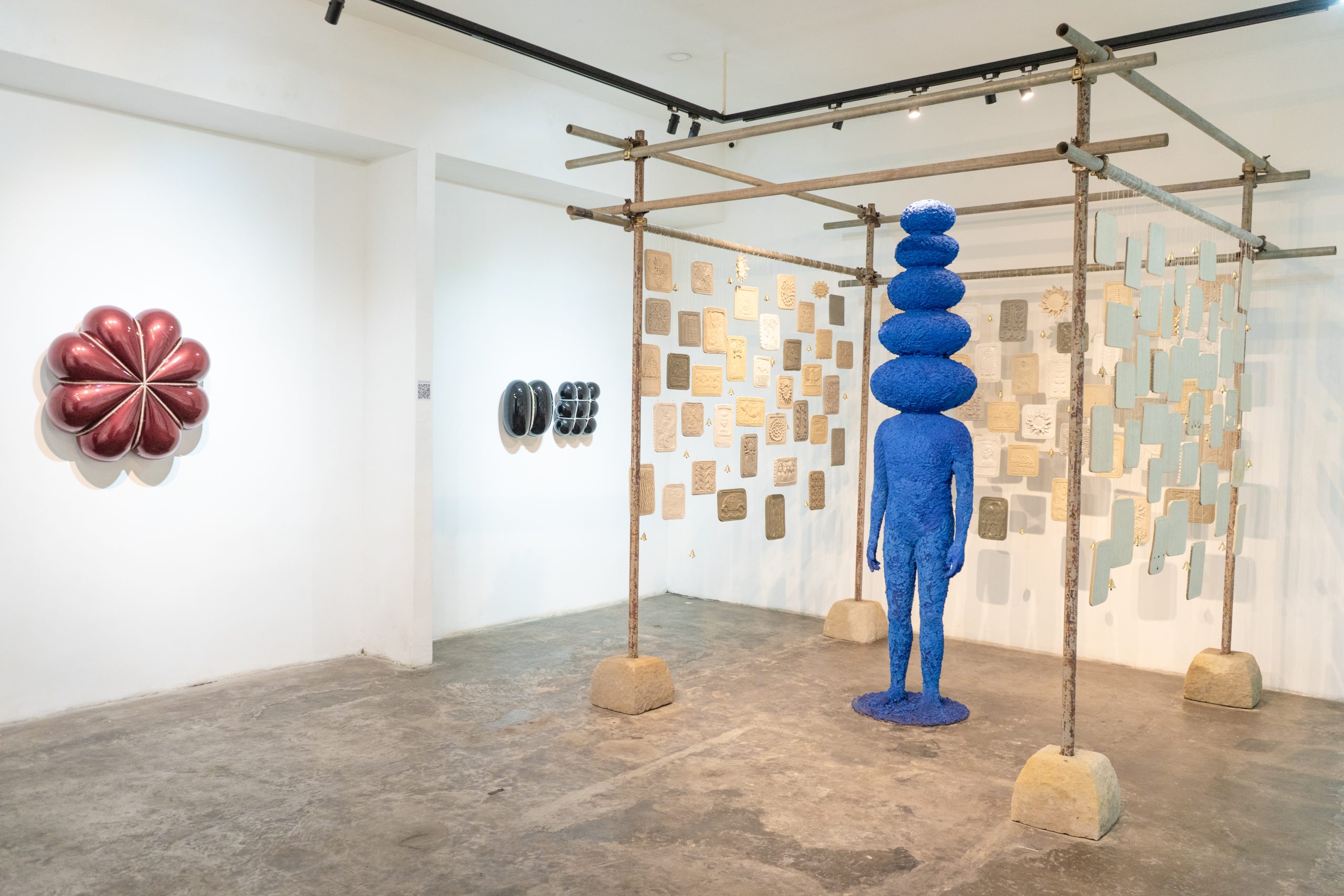
The central installation, “Watugunung” (2026), embodies these notions. Titled after the mythological figure associated with cosmic disruption and eventual realignment, the work features a life-sized papier-mâché figure in cobalt blue. Its heavily textured, rough concrete or stone-like surface gives it a rugged presence despite the fragility of its material. Where the head should be, five ovate forms are stacked in descending order, suggesting accumulated responsibilities, earthly burdens, and the continual search for steadiness.
The figure stands enclosed in a square, see-through structure constructed from reclaimed iron poles. Ceramic tiles made from stoneware clay waste and glaze remnants partially cover the grid structure. Fired in subdued tones of light grey, dark grey, greyish-green, white, and light beige, the ceramics bear hand-drawn scenes of objects, animals, peoples, mythical and hybrid figures and objects, spaces, encounters, tenderness, critiques, and hardship. Hung on the structure are small classic-style brass doorbells that visitors are welcomed to ring, filling the space with resonant interruptions that could evoke both invitation and obligation.
As opposed to functioning as symbolic illustrations, the materials and components of the installation are not merely symbols representing ideas. Instead, they produce an experience that visitors enter and participate in with both their bodies and minds—they become an environment that viewers physically and psychologically occupy. The stacked forms evoke the coexistence of strength and vulnerability, while the permeable architecture dissolves rigid boundaries between interior and exterior. The work recalls the principle of Rwa Bhineda and Sekala Niskala, where dualities and opposing forces are held in productive tension: harmony is resolved without trying to eradicate or collapse one into the other.
Surrounding the central structure on the gallery walls is the “Nafas” series objects. These resin wall objects, coloured with automotive paint in deep red, turquoise, black, and yellow take shapes recalling flower petals, clustered round forms arranged in grids, and elongated in lined compositions. Ropes of polycarbonate, jute, and metal fibres wrap around them, creating tension that causes the forms to bulge like inflated pockets of air. At once stiff and flexible, hard and soft, fragile and resilient, these works suggest breath as both necessity and quiet resistance.
The act of binding is central to the series. The ropes functions more than as a means of visual capacity, it draws upon vernacular Balinese practices of attaching, combining, and structuring materials. The acts of binding appear in the making of canang sari offering, the construction of pelinggih (shrines), the wrapping of ceremonial textiles and wears, as well the tying of traditional head coverings, and many others. Likewise, the hand-moulding of forms and the hand-drawn imagery throughout the exhibition echo everyday practices embedded in Balinese material culture.
They can be found from shaping jaja (ceremonial cakes) prepared for offerings such as pulogembal to the linear language found in Balinese painting. These gestures are not quoted as symbols of tradition; they are embodied practices through which relationships between people, materials, and the unseen are continually made and renewed. In “Nafas”, binding simultaneously compresses and supports the resin forms, suggesting that balance emerges not through the absence of tension, but through its continual negotiation.
If “Watugunung” holds the tension between opposing forces, “Nafas” opens space for expansion and possibility. Together, the works create a dialogue between the grounded and the expansive, the enclosed and the permeable, the burdened and the restorative. Waste materials find new life; rigid structures become open frameworks; compressed forms hold the potential for breath. Without intending to resolves oppositions, Upadana reveals equipoise as an ongoing process of negotiating relationships between people, materials, environments, and the unseen.
Inhabiting the in-between
Throughout Equipoise, balance is understood not as a fixed state but as an ongoing practice. Architectural structures become penetrable, industrial waste becomes generative, and familiar boundaries between the material and the spiritual begin to dissolve. The underlining stroke is not asking only how people become attached to places, the exhibition asks how we might participate more reasonably and mindfully in this realm we dwell in.
By bringing environmental psychology into conversation with Balinese-Hindu philosophy, Upadana expands our understanding of place further on than questions of perception, attachment, and identity alone. His artworks propose that presence emerges not only through memory and experience, but also through ethical reciprocity, material transformation, and the continual negotiation of complementary forces. In this sense, Equipoise offers more than an exploration of equilibrium; it presents equity as an active way of interacting and to be present in a landscape where the visible and invisible, the personal and communal, the earthly and the spiritual remain inseparably intertwined.
Fundamentally, Equipoise opens up to viewers as a space to consider their own place within these intersecting realities. In a life shaped by shifting borders, fractured communities, and uncertain futures, Upadana suggests that harmony is neither inherited nor achieved once and for all. It is continually practised through our relationships with people, places, materials, and the unseen forces that shape everyday life. By transforming what has been discarded into spaces of reflection and encounter, the exhibition reminds us that harmony is not the absence of tension but the capacity to settle in it with mindfulness, responsibility, and openness.
Eventually, what questions arise in such a space? How might we reconcile cosmic order with human imperfection? Can equipoise emerge through balancing devotion with duty, certainty with ambiguity, enclosure with openness, conviction with responsibility, and presence with mindfulness? The intention is not to provide definitive answers, but Equipoise urges each viewer to accommodate these questions—and, thereby, to recognise balance not as a destination but as an ongoing process of being in life.