

ALAM SEBAGAI LUMBUNG
There was a time when what graced our plates was a direct reflection of the soil beneath our feet, a legible cycle, a tidy grammar of nature. Today, that chain is broken. We chew on factory-produced landscapes, swallow instant narratives, and slowly grow blind to our own roots. Nature as the Granary (Alam sebagai Lumbung) serves as a pause. Four artists offer their readings on the crises and ironies surrounding our remaining “granaries.” They strip back the layers to show how the “grammar” of our land, traditions, and local food systems has mutated amidst the grinding gears of modernization.
The Archival Memory
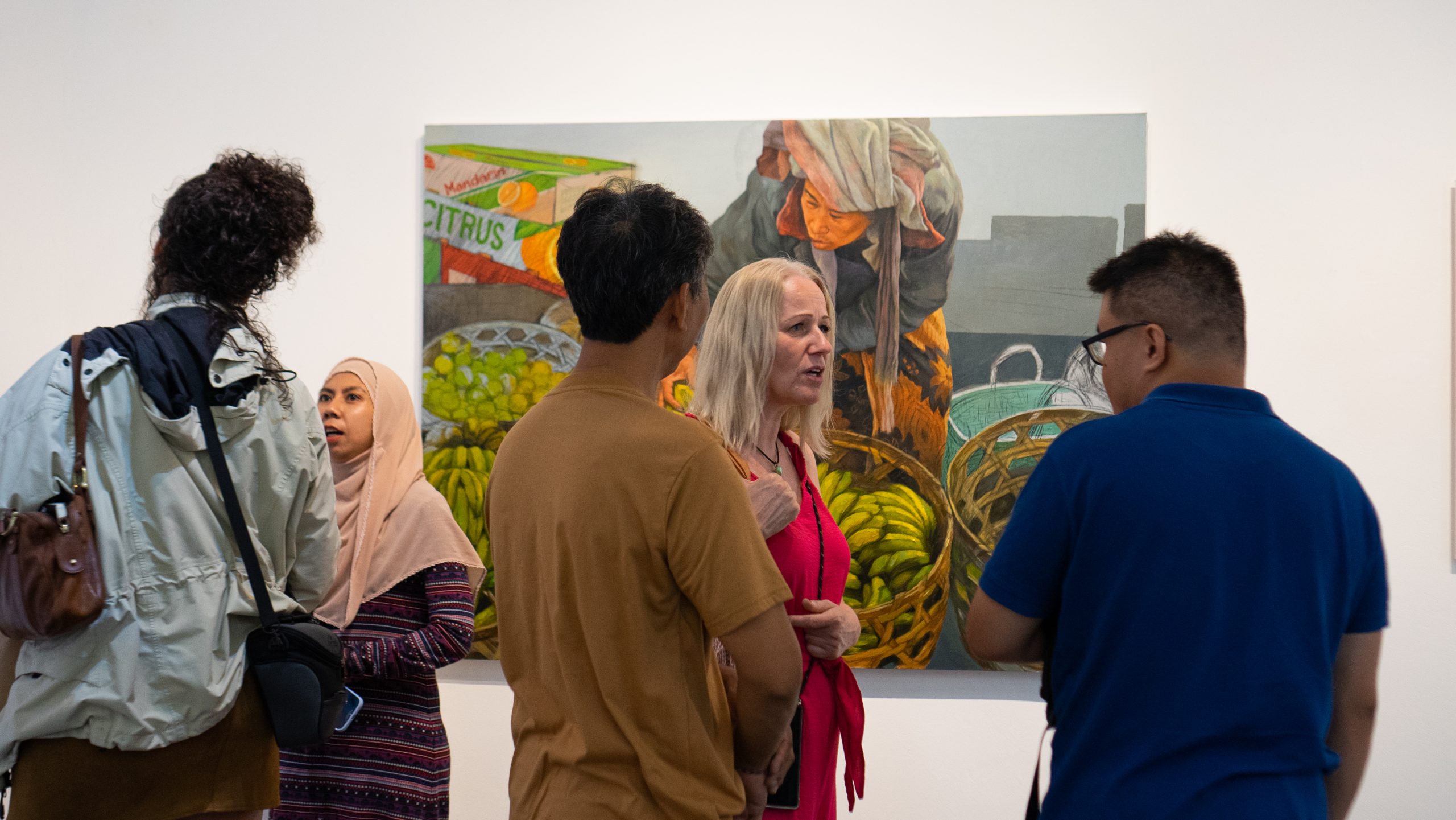
As a foundation, Nyoman Wijaya records the remaining agrarian memory. His classical brushstrokes, capturing the rhythm of rice fields and the labor of farmers, are not mere romanticizations of the
past; they are a visual achievement. His work represents the pure alphabet of this land; a serene vista that is quietly bidding us farewell, squeezed out by the relentless advance of tourism’s concrete.
The Domestic Womb
In a more domestic crevice, Ayu Murniati draws these issues closer to the courtyard and the dining table. Through narratives of flora, female figures, and the elements of daily life, she speaks of the lumbung (granary) not as a physical structure, but as a womb of life. Ayu questions the fate of local seeds and indigenous foodways once nurtured by women’s hands, now evaporating, replaced by the uniform commodities of the global market.
The Urban Intervention
A sharp intervention comes from Slinat, who hacks into agrarian romance by colliding classical figures with urban attributes like gas masks and pop icons. His work is a conscious form of “vandalism”
against a history that is becoming obsolete. Slinat exposes the true face of the present: our aesthetic landscapes are continuously sold, while the actual soil is invaded by pollution and blind consumption patterns.
The Satirical Mirror
Finally, we are confronted by a most satirical mirror through the Monkey Millennial figures by Komang Adiartha. In the form of playful, glossy, and seemingly “expensive” art toys, he dissects the anatomy of our generation. This is a generation whose bodies are molded by industry; intestines twisted by instant noodles and bones brittle from a lack of true nourishment. We feel full and “progressive,” yet we are effectively starving in our own granary.
As you walk through these works, pay close attention to what is being served. We hope that upon leaving this room, your palate regains the ability to distinguish the honest taste of the earth from the mere sweetness of synthetic packaging.