

Geological Living: Quiet Confidence
I have known Tisa Granicia since the early 2000s, when I was still a student at the Faculty of Fine Arts in Bandung. As her junior, I witnessed how she positioned ceramics not merely as vessels, but as bodies. Her realist figurative sculptures in glossy white porcelain, presented on pedestals, brought a stunning freshness to a ceramic studio environment that at the time was largely dominated by formalism and functionality. From the beginning, Tisa treated clay as an equal to ideas — not subordinate to them.
In 2005, together with Uji, Nuri, and Gya, she co-founded Kandura Studio — a collective practice space that functioned not only as a site of production but as a laboratory of dialogue. Between 2015 and 2017, she also initiated a handmade ceramic markets in Bandung and Jakarta, especially in Kineruku, Bandung. These regular gatherings became crucial for the ceramic community: spaces of encounter, knowledge exchange, and equitable monetization. For Tisa, practice has always extended beyond the object; it includes building social ecosystems.
In 2025, Tisa relocated to Bali with her two sons to join her husband who already stays in Bali. This geographical shift marked a new geological layer in her practice. It was during this period that her awareness of material intertwined with an evolving commitment to minimum-waste living. She began incorporating household waste, renovation debris, receipts, and sand into her clay bodies. This experimentation is not merely aesthetic strategy — it is ethical positioning.
Clay itself is geological narrative. It is the result of rock weathering over millions of years — sedimentation, pressure, transformation. In the kiln, clay undergoes metamorphosis once again through fire. Geology teaches us about deep time — a scale of existence that exceeds human lifespan. The earth works silently, yet decisively. Tisa grew up around geological conversations; her father is a geologist. Perhaps this is why her work carries a certain quiet confidence. A rock does not need to prove itself. It exists, enduring millions of years. In this sense, geology embodies a kind of stoic presence.
This attitude resonates strongly with Stoic philosophy. Marcus Aurelius compares the ideal human character to a rock promontory standing firm against waves. Epictetus reminds us that some things are within our control, and others are not. Tisa cannot control industrial systems, but she can control how she works with material. Her reduction of waste, her material consciousness, and her prioritization of regeneration for her children reflect a contemporary stoic practice — living according to nature.
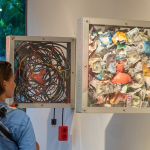
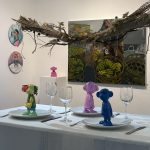
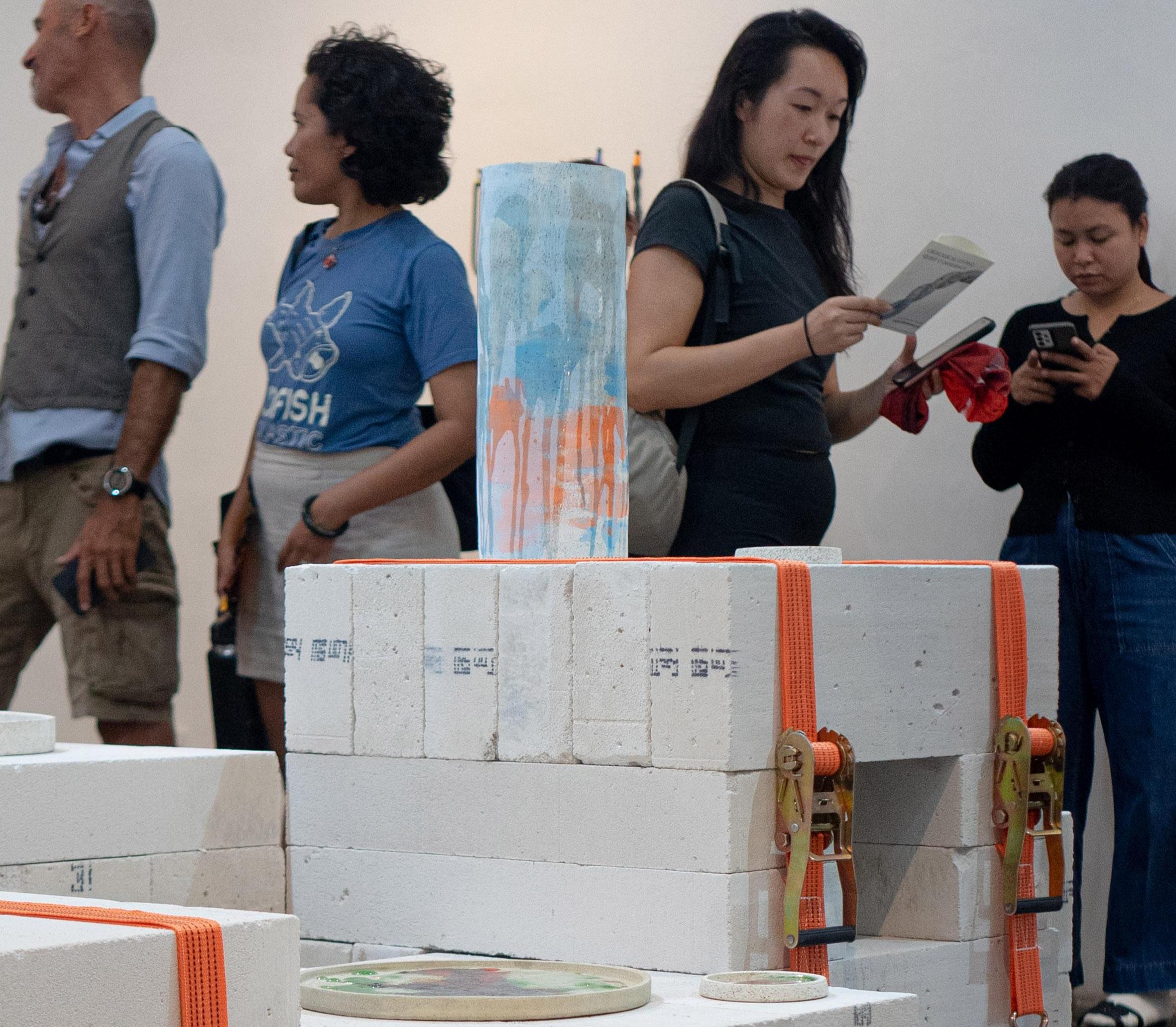
“Geological Living” speaks to a layered way of being. Like the earth’s strata that quietly determine the future, Tisa’s small daily decisions accumulate into structural change. The exhibition unfolds geologically across spaces. It begins at Dalam Seniman, Ubud, where visitors encounter her organic forms: supple wall pieces tied in knots, glass glazes melting into small pools revealing fine cracks, and cylindrical vases with textured surfaces. Experiencing these works bring up familiarity. Perhaps because ceramics carries one of humanity’s longest artistic histories — from prehistoric vessels to porcelain traditions, from Nusantara earthenware to the Arts and Crafts movement that reclaimed craft as fine art.
At Seniman Cube, Kemenuh-the second spaces, Tisa opens her process to the public through participatory sessions. The studio becomes exposed strata. Viewers witness negotiation between earth, water, and fire. Finally, at Dalam Seniman Renon/Sanur, works from both previous venues converge. Here, processes and artifacts accumulate like sedimentary layers. The exhibition becomes stratified. Edward Said reminds us that familiarity is historically constructed. Our intimacy with clay
is not neutral; it is civilizational memory.
In Tisa’s practice, simplicity is never simplistic. To make something simple is far more difficult than to make it loud. There is intention — to care, to sustain, to prioritize. Her woman hood, often demanding multitasking across domestic and professional realms, becomes integrated into her artistic methodology. The result is not spectacle but presence. “Geological Living: Quiet Confidence” is about endurance. Like stone, these works do not shout. They stand. And in standing, they affirm.